

ZZ Plant Apartment Guide: Exact Indoor Setup That Actually Works
The zz plant apartment setup is often recommended as “easy,” but most failures indoors come from vague advice like low light and water occasionally. This guide breaks down the exact indoor setup that works in real apartments, including placement, light limits, and the common mistakes that quietly kill zz plants indoors.
As a houseplant, the zz plant indoors is built for survival, not speed. It tolerates low light, infrequent watering, and long gaps between attention, but only when the zz plant apartment setup matches how it actually grows inside homes.

Disclosure: Some links are affiliate links. If you buy through them, we may earn a small commission at no extra cost to you.
Is a ZZ Plant Right for Your Apartment? (Go / No-Go Check)
A ZZ plant apartment setup can work extremely well indoors if your expectations match how the plant actually grows. This is not a fast-growing or interactive houseplant. For long periods, a zz plant indoors may look unchanged, and that is completely normal.
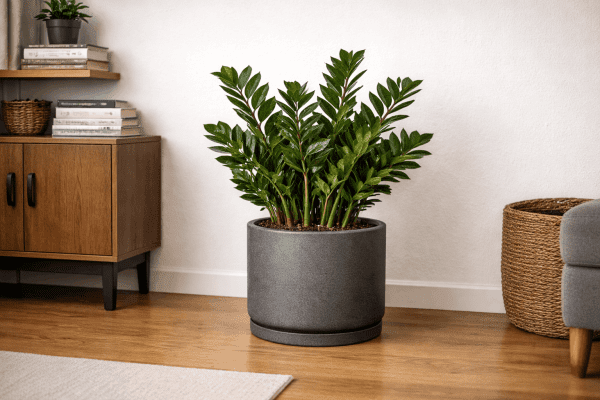
This plant is best treated as a long-term houseplant rather than a decorative feature that changes week to week.
Because the zz plant grows slowly but steadily over time, its physical footprint matters more than most people expect in apartments. According to the Missouri Botanical Garden, a mature zz plant typically reaches 60–90 cm (2–3 ft) tall, with thick upright stems and a heavy base formed by underground rhizomes. This makes it better suited to floor placement, a low plant stand, or sturdy furniture, not narrow shelves or lightweight surfaces.
As it matures, the combined weight of the stems and underground rhizomes can make small shelves unstable or tip-prone.
A ZZ plant is a good fit for your apartment if:
- You are comfortable with slow or seasonal growth.
- You prefer watering every few weeks, not weekly.
- Your space has indirect or low natural light (ideal for a zz plant low light apartment).
- You want a plant that tolerates being left alone.
- You can avoid decorative pots without drainage (key to preventing zz plant overwatering).
A ZZ plant is NOT a good fit if:
- You expect visible growth or change every week.
- You water plants on a fixed schedule instead of checking soil dryness.
- You plan to plant directly into decorative pots without drainage.
- You want a plant that responds quickly to care adjustments.
This plant rewards restraint. The less you intervene, the better a zz plant indoors performs.
Apartment Space & Size Reality (Often Overlooked)
In a zz plant apartment, plants grow upright and dense. While they start compact, a healthy zz plant indoors commonly reaches 60–90 cm (2–3 ft) tall over time.
This creates a few apartment-specific constraints that are often ignored when choosing placement for a zz plant indoors:
- Mature ZZ plants become top-heavy, especially in lightweight or decorative pots.
- Narrow shelves, window ledges, and floating furniture are poor fits for a zz plant apartment setup.
- Crowded walkways increase the risk of stems snapping or pots tipping.
- Small decorative pots become unstable as the plant gains height, even if the plant appears to be not growing for long periods.
Best placement in apartments:
- Floor-level positions with lateral space.
- Low stands or wide, stable plant bases.
- Areas where the plant will not be brushed or bumped.
For many zz plant apartment setups, a low, wide metal plant stand designed to support heavier pots can help keep a mature plant stable as it gains height, without raising it into bump-prone shelf space.
If your only available space is a narrow shelf, windowsill, or high ledge, a zz plant indoors is likely to become unstable or inconvenient long-term, even in low-light apartments.
This is a slow-growing plant, but it does grow. Plan for its final size, not its nursery size.
Do NOT Buy a ZZ Plant If These Apartment Conditions Apply
Do not buy a ZZ plant if any of the following indoor apartment conditions apply to your space. These setups consistently cause slow decline or failure for ZZ plants indoors, even when care seems minimal.
Decorative Pots Without Drainage (High-Risk Apartment Trap)
If you plan to plant a ZZ plant directly into a decorative pot without drainage holes, this plant is not for you.
ZZ plants store water in thick underground rhizomes. When excess moisture cannot escape, those rhizomes rot quietly below the soil surface. ZZ plant overwatering indoors most often happens this way, especially inside sealed ceramic or concrete pots where water pools unseen.
In severe cases, expanding rhizomes can even crack decorative pots as they swell under constant moisture.
Always keep ZZ plants in their nursery pot or a container with drainage, then place that inside a decorative cover pot system designed for inner nursery pots if needed. This setup dramatically reduces the risk of overwatering in apartments.
Strong HVAC Airflow or Cold Draft Exposure
Avoid ZZ plants if your apartment has strong air-conditioning or heating vents blowing directly onto plants.
Cold airflow combined with damp soil accelerates rot. This “cold + wet” interaction is one of the fastest ways ZZ plants fail indoors, particularly in air-conditioned apartments where evaporation is already slow.
If you cannot place the plant away from vents, drafts, or constant airflow, long-term survival is unlikely. In apartments where vents can’t be moved, a simple air vent deflector can redirect airflow away from plants without affecting room comfort.
Other Apartment Deal-Breakers
A ZZ plant is also a poor choice if:
- You plan to place it in a windowless room while relying on vague “low light” claims
- You prefer weekly watering, regardless of soil dryness
- You have free-roaming pets, ZZ plants are toxic if chewed and unsuitable for homes where pets can access the leaves
ZZ plants fail quietly. They often look fine for weeks while roots or rhizomes weaken below the surface. If your setup encourages ZZ plant overwatering, poor drainage, or cold exposure, the plant will decline slowly, often without obvious early warning signs.
What This ZZ Plant Actually Needs Indoors
ZZ plants adapt well to most indoor apartment environments as long as light is indirect, watering is infrequent, and drainage is not restricted. When these basics are right, a ZZ plant indoors remains stable, resilient, and genuinely low-maintenance.
Can a ZZ Plant Grow in Low-Light Apartments?
ZZ plants are tolerant of low light, but low light does not mean no light. A simple rule works well in apartments: if you can comfortably read a book in that spot during the day, the plant can survive there.
Low light conditions are common in apartments, and a zz plant low light setup can still succeed when there is usable ambient daylight, even if the plant sits several feet away from a window.
If your apartment stays dim most of the day, you may also want to explore other low light indoor plants that thrive in north-facing or shaded rooms.
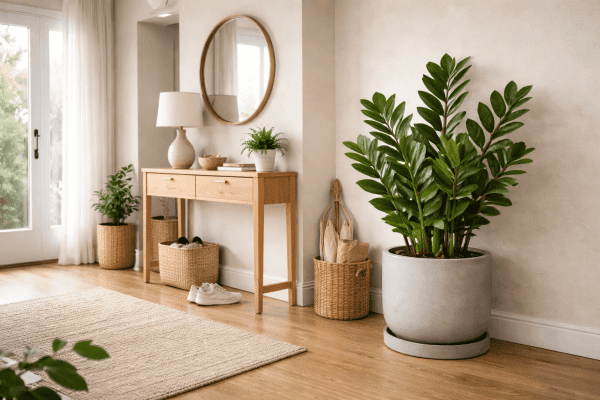
Best placement indoors:
- Bright rooms with indirect light
- Several feet away from a window
- Areas with consistent daytime ambient light
In proper light, ZZ plants maintain shiny, healthy leaves without needing direct sun or window exposure..
If an apartment feels dim during the day, a daylight-tone floor lamp can help lift overall room brightness without aiming light directly at the plant. This improves ambient light levels in darker rooms and supports steady ZZ plant indoor growth without turning the space into a grow-light setup.
Avoid placing ZZ plants indoors in:
- Windowless bathrooms
- Deep interior corners with artificial light only
- Spots that stay dark all day
Low light naturally slows growth. This is normal and not a problem unless combined with zz plant overwatering, which is the most common reason a ZZ plant struggles indoors. Many cases of a zz plant not growing are simply the result of low light paired with excess moisture, not poor health.
Why Overwatering Is the #1 Reason ZZ Plants Fail Indoors
ZZ plants store water in thick underground rhizomes. When watered too frequently, these storage organs rot before the leaves show any visible damage. This is why zz plant overwatering is the most common cause of failure indoors, even in apartments that otherwise seem suitable.
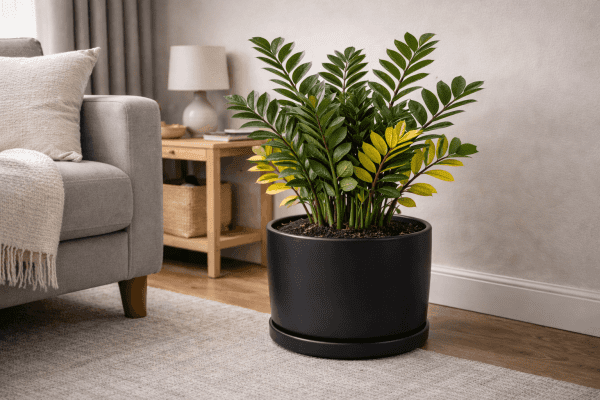
ZZ plants evolved to survive drought, which is why excess water causes more damage than dryness indoors. As noted by NC State Extension, ZZ plants store water in thick underground rhizomes, allowing them to tolerate long dry periods but making them highly sensitive to consistently wet soil. In a zz plant apartment setup, moisture that lingers too long in the soil creates the perfect conditions for root and rhizome rot.
Thanks to their underground rhizomes, zz plants indoors can survive months without water, which is why frequent watering, rather than neglect, is the leading cause of decline. This is especially true in zz plant low light apartments, where evaporation is slow and soil stays wet longer.
Lack of visible growth is normal. In stable indoor conditions, a healthy zz plant not growing for 3–6 months is completely expected, particularly in low light or outside the active growing season. During these quiet periods, increasing water or fertilizer is the fastest way to trigger root rot.
Key watering rules for apartments:
- Water only when the soil has fully dried.
- Expect watering every 2–4 weeks, sometimes longer.
- Reduce watering further in zz plant low light rooms.
During the indoor growing season, watering frequency may increase slightly, but only if light levels are adequate and the soil dries fully between waterings. In most apartments, erring on the side of dryness is safer than keeping soil consistently moist.
Always wait until the soil dries completely before watering again, especially for zz plants indoors kept away from bright windows.
Common apartment mistake:
- Adding small amounts of water frequently.
Frequent light watering is worse than infrequent deep watering. Indoors, dryness protects the roots, moisture destroys them. If a zz plant apartment setup struggles, overwatering is almost always the reason.
Pot Size and Soil Setup That Prevent Root Rot and Support Healthy Growth in Apartments
Pot choice matters more than fertilizer or misting for a zz plant indoors, especially in apartments where airflow and drying time are limited.
Minimum setup that works:
- A pot with clear drainage holes to prevent zz plant overwatering.
- A fast-draining soil mix designed for indoor plants, a cactus or succulent potting mix works well for ZZ plants because it dries quickly and helps reduce the risk of root rot indoors.
- A pot that is only slightly larger than the root mass, not oversized.
Oversized containers are one of the most common causes of zz plant overwatering indoors, even when watering frequency seems reasonable. Excess soil holds moisture long after the roots are finished using it.
Avoid:
- Oversized pots that stay wet for days.
- Decorative containers without drainage holes.
- Dense soil that remains damp and poorly aerated.
ZZ roots expand outward with force over time. Keeping the plant in its nursery pot inside a decorative cover allows excess water to drain properly while making future repotting easier and safer for apartment setups.
This setup is especially important if your zz plant is not growing, poor drainage often causes slow decline long before leaves show visible damage.
Temperature and Airflow Issues That Quietly Stall ZZ Plant Growth
ZZ plants tolerate normal indoor temperatures well, but they react poorly to constant air circulation, which is common in apartments.
Typical indoor humidity levels are not a problem for a zz plant indoors as long as airflow is stable. Even low-humidity conditions in air-conditioned apartments are usually tolerated if the plant is not exposed to direct drafts.
However, airflow combined with damp soil dramatically increases the risk of zz plant overwatering, especially in low-light apartments where evaporation is slow.
Avoid placing ZZ plants:
- Directly under air-conditioning vents.
- Near heaters or forced-air outlets.
- In drafty corridors or doorways.
Cold or dry airflow weakens stems and dries leaf tissue over time, even when temperatures feel comfortable. In many cases, a zz plant not growing is reacting to environmental stress rather than a lack of nutrients or light.
Apartment Setup for a ZZ Plant Apartment
In a zz plant apartment, long-term success depends more on stability and placement than on frequent care or equipment.
This is the simplest setup that consistently works in apartments. Once the basics are right, adding more equipment does not improve outcomes, placement decisions do.
In apartments, mature ZZ plants become taller and heavier over time. Unstable locations are the most common long-term problem, not light or watering.
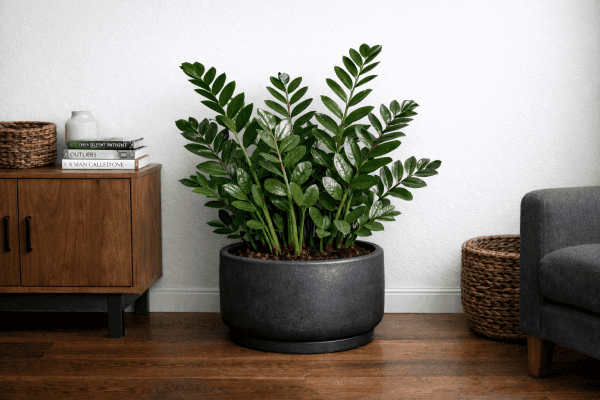
What works best in real apartments:
• Floor-level placement rather than shelves or window ledges
• A stable, wide base that won’t tip as the plant gains height
• A low-traffic area where the plant won’t be bumped or brushed past
• Consistent ambient light, several feet back from a window
Elevating a mature ZZ plant often creates more problems than it solves. Stability matters more than height.
A heavy ceramic floor planter with a wide base can help keep a mature ZZ plant stable in apartments, especially once it reaches full height.
Once you choose a good spot, leave it alone. Frequent repositioning slows adaptation and increases watering mistakes.
Mistakes That Kill ZZ Plants in Apartments
Most ZZ plant failures come from well-intended adjustments.
Common mistakes:
- Watering before the soil has fully dried.
- Using oversized pots “to allow growth”.
- Planting directly into heavy decorative containers.
- Fertilizing to fix slow growth in low light.
- Placing the plant under constant HVAC airflow.
- When handling damaged stems without protection, the plant sap can irritate skin, especially during pruning or repotting.
ZZ plants decline slowly. By the time yellowing or soft stems appear, root damage has often already occurred.
ZZ Plant Troubleshooting Signals
Use this fast scan to identify problems early.
- Yellowing leaves → Soil staying wet too long → Let soil fully dry, reduce watering.
- Soft or collapsing stems → Root rot beginning → Remove from pot, trim damaged roots, repot dry.
- No growth for months → Low light or dormant period → Normal indoors, do not increase watering.
- Brown leaf tips → Dry airflow or vent exposure → Relocate away from drafts.
Healthy ZZ plants maintain firm, glossy leaves, even when growth is slow indoors. They also tolerate low humidity well, making dry indoor air rarely a problem unless combined with overwatering.
If any signs of problems, fix the setup first. Do not add fertilizer or water to “help” recovery.
ZZ Plant Apartment Alternatives (If This One Fails Your Constraints)
If the ZZ plant does not match your apartment conditions, consider these instead:
- Snake plant: Better tolerance for darker rooms and upright growth, compare it with a ZZ plant in our Snake plant apartment care guide.
- Cast iron plant: Handles low light and irregular care with less rot risk.
- Pothos: Faster growth if you want visible change and feedback. Many apartment growers use simple [plant propagation stations with glass test tubes] to root cuttings on shelves or desks without committing to another full pot.
Each alternative solves a different constraint that causes ZZ plants to fail.
Final Verdict: Who the ZZ Plant Is (and Is Not) For
The ZZ plant works best for apartment dwellers who want survival over speed. This also makes it a strong office plant, especially in low-maintenance workspaces where watering is infrequent and light is indirect. It thrives when left alone, watered infrequently, and kept in stable indoor spaces with consistent conditions.
If you prefer hands-off care and slow, steady performance, the ZZ plant is a reliable choice. If you want visible progress or weekly interaction, it will feel unresponsive and frustrating.
This plant is toxic to pets, so it only works in homes where cats and dogs cannot access the leaves.
Set it up correctly once, then resist the urge to intervene.
Disclosure: Some links are affiliate links. If you buy through them, we may earn a small commission at no extra cost to you.
